Guide
What Are Real Estate Concessions? A Closer Look for Sellers and Buyers

A real estate concession is a credit the seller gives the buyer at closing, and it lowers what the seller takes home, dollar for dollar. Used well, it keeps a good deal together without changing the recorded purchase price. Here is how concessions work, when they come up, and how to weigh them as a homeowner across Mercer Island, Bellevue, and the Greater Eastside.
What a concession is, and what it is not
A concession is money the seller agrees, in the purchase contract, to put toward the buyer's costs at closing. It might cover part of the buyer's lender fees, title and escrow charges, prepaid property tax and insurance, a mortgage rate buydown, or repairs that came up during the inspection.
The purchase price on paper stays the same. The money simply moves from your proceeds to the buyer's closing costs.
A concession is not a discount that costs you less. A credit usually costs you at least as much as a price reduction of the same size, and sometimes a little more. What changes is everything around that number: the price recorded as a reference point for nearby homes, how the home appraises, how much cash the buyer needs at the table, and how the buyer's loan is structured.
When sellers offer them, and when buyers ask
Concessions tend to show up when buyers have more choices and homes take longer to sell. They also appear in any market when one specific obstacle stands between two sides who otherwise agree.
Sellers often offer a credit when:
- A home has been listed longer than similar homes nearby, and a credit may draw an offer faster than a price cut.
- Inspection findings come up, and a credit is simpler than coordinating contractors before closing.
- Higher mortgage rates are stretching buyers, and a rate buydown makes the monthly payment work.
- The seller needs a firm closing date, for example, to line up with the purchase of the next home.
Buyers often ask for a credit when:
- Their cash is committed to the down payment, and they need help with closing costs.
- They want a lower monthly payment through a rate buydown.
- Inspection turns up repairs they would rather fund themselves than negotiate over.
How much a seller can give
The buyer's lender sets the ceiling, not the buyer or the seller. The limits below are the common ones for a buyer's primary residence, and a credit also generally cannot exceed the buyer's actual allowable closing costs.
| Buyer's loan | Typical maximum seller credit | What it depends on |
|---|---|---|
| Conventional | 3% of the price | Buyer puts down less than 10% |
| Conventional | 6% of the price | Buyer puts down 10% to 25% |
| Conventional | 9% of the price | Buyer puts down more than 25% |
| FHA | 6% of the price | Price or appraised value, whichever is lower |
| VA | 4% for certain concessions | Based on the property's reasonable value, with ordinary closing costs treated separately |
| USDA | 6% of the price | Eligible rural areas |
Loan programs update their rules, so ask the buyer's lender to confirm the current limit before you agree to a number.
What a concession does to your net proceeds
Every dollar of credit comes straight out of what you take home. This example is an illustration only. The $50,000 credit is a sample amount chosen to make the numbers easy to see, not a typical or recommended one, and real credits vary widely. Say a Bellevue home is under contract at $1,500,000 and the buyer asks the seller to pay $50,000 of the buyer's loan costs.
| Compare the versions | No concession | $50,000 credit | $50,000 price reduction |
|---|---|---|---|
| Purchase price on the contract | $1,500,000 | $1,500,000 | $1,450,000 |
| Credit to the buyer at closing | $0 | $50,000 | $0 |
| Costs figured from the price, such as commission and excise tax | $115,755 | $115,755 | $111,865 |
| Left before your mortgage payoff and other costs | $1,384,245 | $1,334,245 | $1,338,135 |
| Price recorded as a reference for nearby homes | $1,500,000 | $1,500,000 | $1,450,000 |
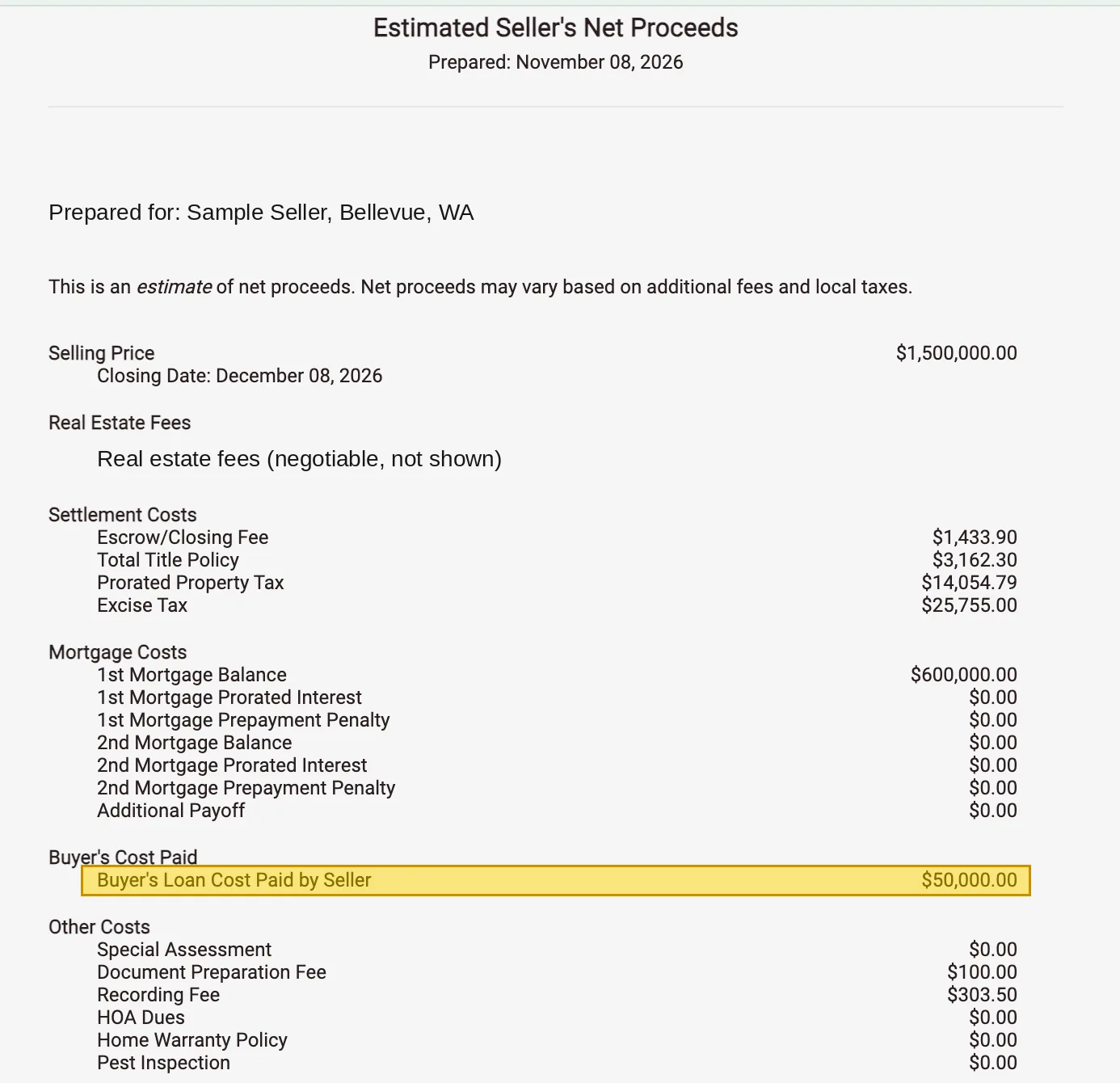
In this illustration, the credit leaves you about $3,890 less than a price reduction of the same size, because commission and Washington's real estate excise tax are typically still figured on the full $1,500,000. The credit does keep the recorded price at $1,500,000 and lowers the cash the buyer needs at the table.
The figures assume commission is a percentage of the contract price, and your own listing agreement, taxes, and loan terms will change the real numbers. Commissions are negotiable. Ask your escrow officer to run each version on a net sheet so you can see the real difference, and ask your CPA how any credit affects your reported proceeds.
A credit that closes on your timeline can be worth more than holding out for a higher number while you keep paying the taxes, insurance, utilities, and upkeep on a house you are ready to leave.
What a concession does to closing costs
For the buyer, a credit lowers the cash needed at closing. Within the lender's limits, it can be applied to lender fees, title and escrow charges, prepaid items like property tax and insurance, and rate buydown costs.
For the seller, the credit appears on the settlement statement as a line next to the costs you already expect: commission, escrow fees, certain title charges, and Washington's real estate excise tax. That tax is graduated, running from 1.1% up to 3% depending on the price tier, and the seller typically pays it.
The net sheet brings it all together. Ask for one before you respond to any offer that includes a credit.
A local tip before you answer an offer
Homeowners across Mercer Island, Bellevue, and the Greater Eastside, from Issaquah and Kirkland to Redmond, Renton, and Sammamish, are often weighing a sale and a purchase at the same time. As a downsizing advisor, I help my clients decide whether accepting or offering a concession fits their right-sizing goals.
In practice, I walk clients through three questions. What do you net under each offer version? Does it keep your closing date in step with your next home? Does the monthly cost of the place you are moving to still feel comfortable?
My suggestion: ask for two net sheets side by side before you answer, one with the credit and one with the matching price reduction, and let your timeline break the tie. When you buy your next home, a credit can protect the cash from your sale. If you are buying with cash, a price reduction is usually the simpler tool.
To talk through your own numbers, call (206) 795-7082.
Frequently asked questions
What is a seller concession in real estate?
A seller concession is a credit the seller agrees to give the buyer at closing, usually toward closing costs, a rate buydown, or repairs. The purchase price stays the same, and the credit comes out of the seller's proceeds.
Is a seller concession the same as lowering the price?
No, and the cost to the seller can differ slightly. A credit and a price reduction of the same size both lower your proceeds, but commission and excise tax are typically still figured on the full price when you give a credit, so the credit can cost a little more. The credit keeps the recorded price higher and lowers the buyer's cash needed at closing.
How much can a seller give in concessions?
It depends on the buyer's loan. Conventional loans allow 3% to 9% of the price based on the down payment, FHA and USDA allow up to 6%, and VA allows up to 4% for certain concessions. Lenders also generally limit credits to the buyer's actual allowable closing costs.
Do concessions reduce how much money I take home?
Yes. Every dollar of credit reduces your proceeds by a dollar, so compare it with a price reduction and with your carrying costs on a net sheet before you agree.
Can a buyer paying cash ask for a concession?
Yes, a cash buyer can negotiate a credit, and no lender limits apply. Cash buyers usually have fewer closing costs, though, so a price reduction is often the simpler tool.
Should I accept a concession if I am downsizing?
It depends on your net proceeds, your closing date, and the timeline for your next home. A credit that closes on schedule can serve a downsizing plan better than a higher price that drags on, so run both versions on a net sheet first.

About the Author
Sharon Glatz ScottSharon Glatz Scott is a Global Real Estate Advisor with Realogics Sotheby's International Realty, serving Mercer Island, Bellevue, and the Greater Eastside. Rooted on Mercer Island since 1977, her focus is downsizing and life-transition real estate: helping homeowners move from a house that has become too much to a home that fits the life they want next.
Published November 8, 2026 · Last updated November 8, 2026
This guide is general information, not legal, tax, or lending advice. Talk with your lender, escrow officer, and CPA about your own situation.